Street Fighter coloring activities can help children look closely at a character's stance before deciding on colors. Open the Street Fighter 6 coloring page collection and pick a Ryu picture, a Chun-Li picture, and one two-person scene. Capcom's Street Fighter 6 materials identify the fighters and the game's World Tour training and Battle Hub settings. The exercises here are original fan activities about shape, motion, and friendly storytelling, not lessons in real-world fighting.
The color illustrations below are AI-generated activity scenes. Printable black-and-white sheets are in the linked collection. This independent fan activity is not official game instruction.
Set out colored pencils, three printed pictures, tracing paper or a blank sheet, and two small cards. Children who like drawing can make a pose study. Those who prefer games can make a paper match announcement. Everyone can take part without needing to know a move list.
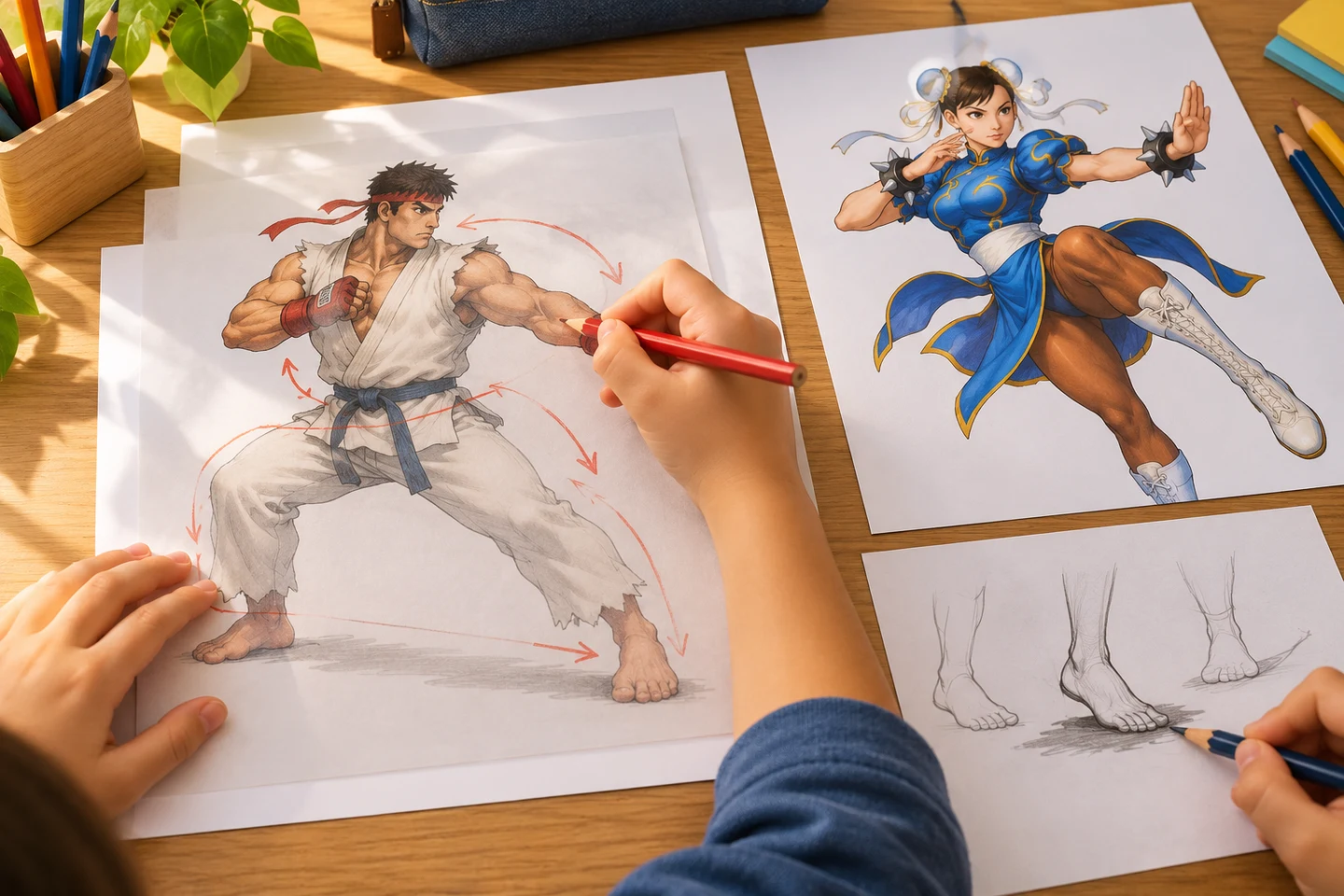
A removable overlay helps children see a pose before committing color to the page.
Begin with a character pose study
Begin by pointing out the character's head, hands, feet, and direction of attention. On tracing paper laid over the print, draw a loose line from head to shoulders and another from hips to feet. These are gesture lines, not a demand to copy every feature perfectly. Remove the overlay and compare it with the original picture.
Now color one large clothing shape, one smaller detail, and the ground beneath the character. Leave areas between arms and body white until the silhouette is clear. If a costume detail is hard to identify, check Capcom's official art before adding it; do not guess a new uniform from a search thumbnail. A clear pose matters more than finishing the background.
For younger children, try a “still statue” version. Stand in a safe, balanced pose for a few seconds and ask which leg supports the weight. No punching or contact is needed. Then return to the paper and color the supporting foot's shadow. The activity connects body balance to the image without asking anyone to imitate a fight.
Compare two character pose studies
Give Ryu and Chun-Li distinct palettes across their two sheets. Give the Ryu sheet a quiet practice task: color the figure first, then add only a few lines in the training space. Give Chun-Li a movement task: choose one part of her pose to emphasize with color and keep the surrounding space light. The goal is not a competition over which character is stronger. It is to notice how two figures can communicate different kinds of motion.
Make two mini cards from spare paper. On each, write or draw one observation: “steady feet,” “turning body,” “looking forward,” or another visible detail. Lay the cards beside the matching sheet. A child who cannot yet write can mark arrows or circles. When the pictures are finished, ask them to swap cards and explain whether the observation still fits.
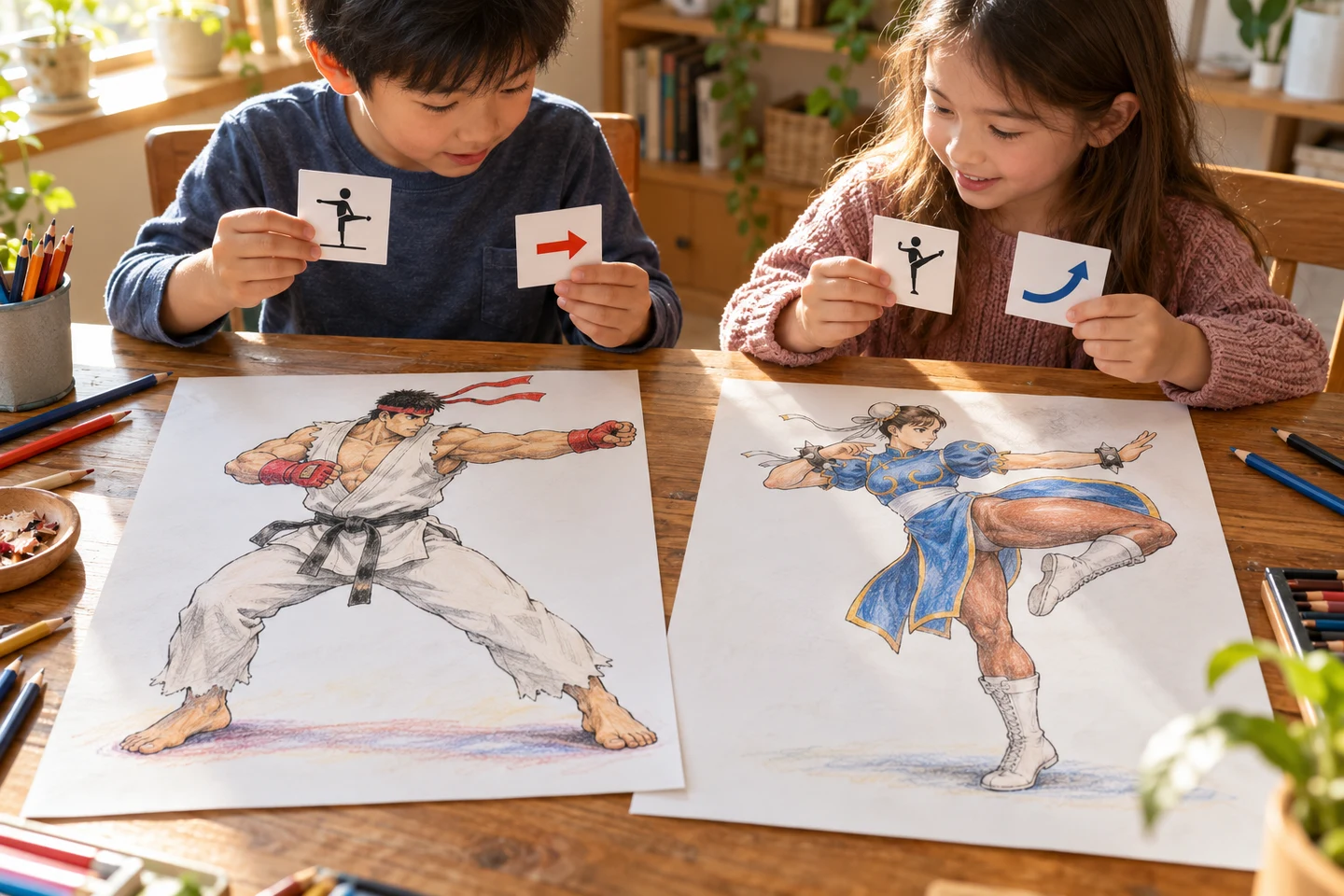
Pose symbols and arrows help the children compare each fighter's balance and movement.
Make a paper match card without scoring
Street Fighter coloring activities can also turn a two-person scene into a friendly match card. Draw a wide border on a new sheet and place the colored picture in the center. Add three boxes underneath: “Before,” “During,” and “After.” The first box can show the fighters greeting each other; the middle can show movement or a respectful pause; the last can show a return to practice. The children can draw rather than write.
The official Street Fighter 6 manual describes World Tour as a place to study under legendary fighters and Battle Hub as a place with battle cabinets. Those settings can inspire another story: a student asks Ryu or Chun-Li for a lesson, watches a match, then tries a balancing pose on paper. Do not label a made-up scene as an official tournament or add an unverified stage name.
If the group wants a challenge, give each person a role: color artist, caption writer, or layout editor. After ten minutes, rotate. Rotating those jobs makes the match card a shared project. Display the paper match card beside the two finished pose studies.
Try a quiet Battle Hub layout
For a second activity, use a picture of players at Battle Hub cabinets. Keep screens blank or show simple shapes; printed text is unnecessary. Ask children to choose how to color the two sides of the room so viewers can follow where each player sits. A strong border or one accent color is enough. This changes the focus from character clothing to scene composition.
Compare the Battle Hub scene with the character sheets. Which picture is easiest to understand from across the room? Which has the most small spaces? Which would you print again for a younger child?
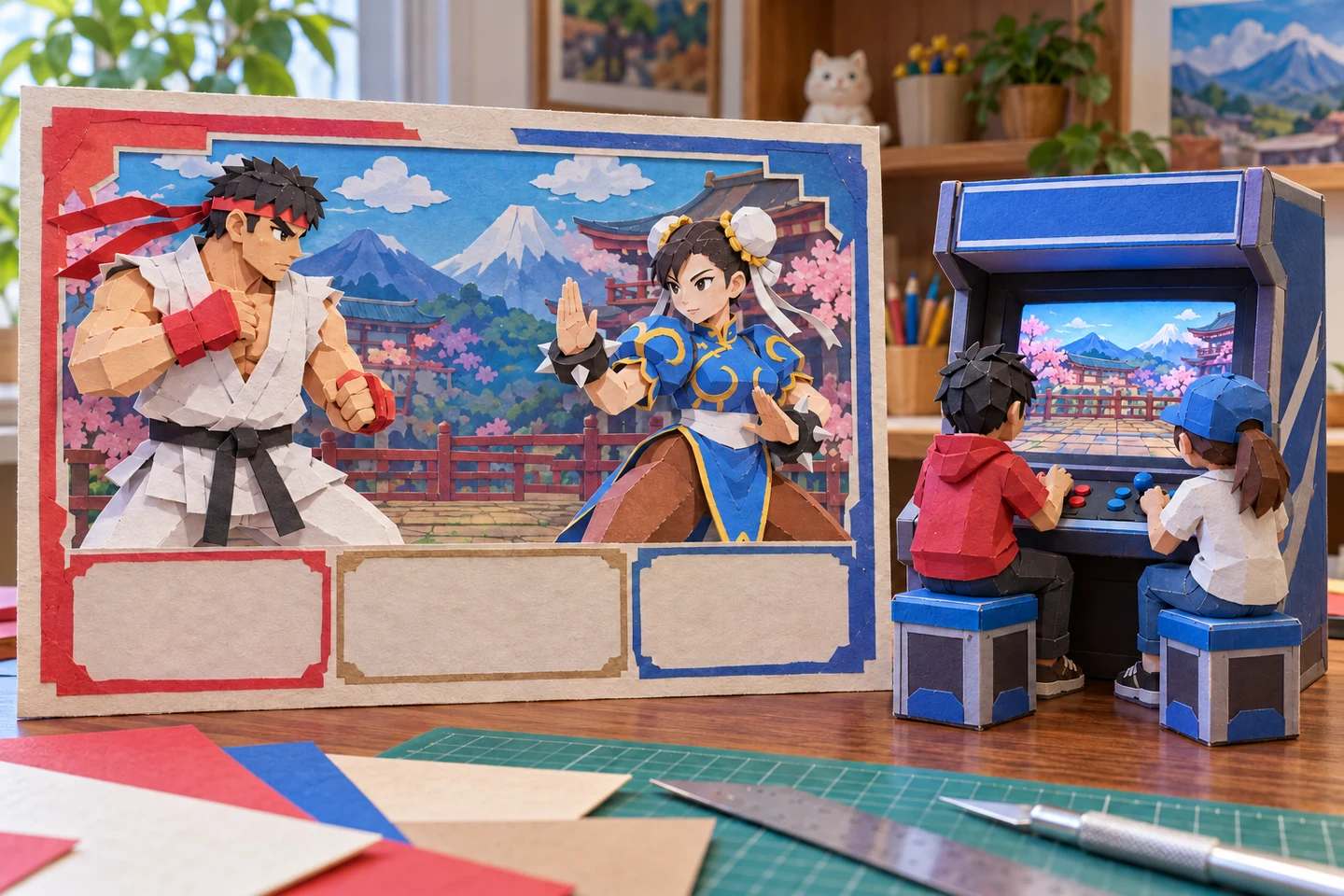
The fighter display leaves three boxes open for notes beside the Battle Hub cabinet scene.
Prepare clean prints and a safe activity
Test one page at A4 or Letter size. Look at fingers, facial lines, and spaces between limbs. If those details close up in print, choose a simpler sheet or a larger scale. Pencils give more control than broad markers for intricate costume sections. Keep tracing paper separate so children can reuse a pose image without drawing over it.
These are paper character and story activities. Keep imitation poses gentle, stationary, and non-contact. If you want a different composition, the AI coloring page tool accepts written descriptions; creation requires sign-in and credits, so check the displayed cost and inspect the output before printing. Browse the community gallery for other public art. For a cooperative fantasy route, read Minecraft Dungeons coloring activities. For character-led storytelling in another world, see Adventure Time RPG coloring activities.
Street Fighter coloring activities give you more than a finished portrait when children can point to the pose they noticed and explain the story they built around it.